What Is a Schottky Diode?
A diode lets current flow one way. A Schottky diode does the same job with less energy wasted — which is why chargers and power supplies use them.
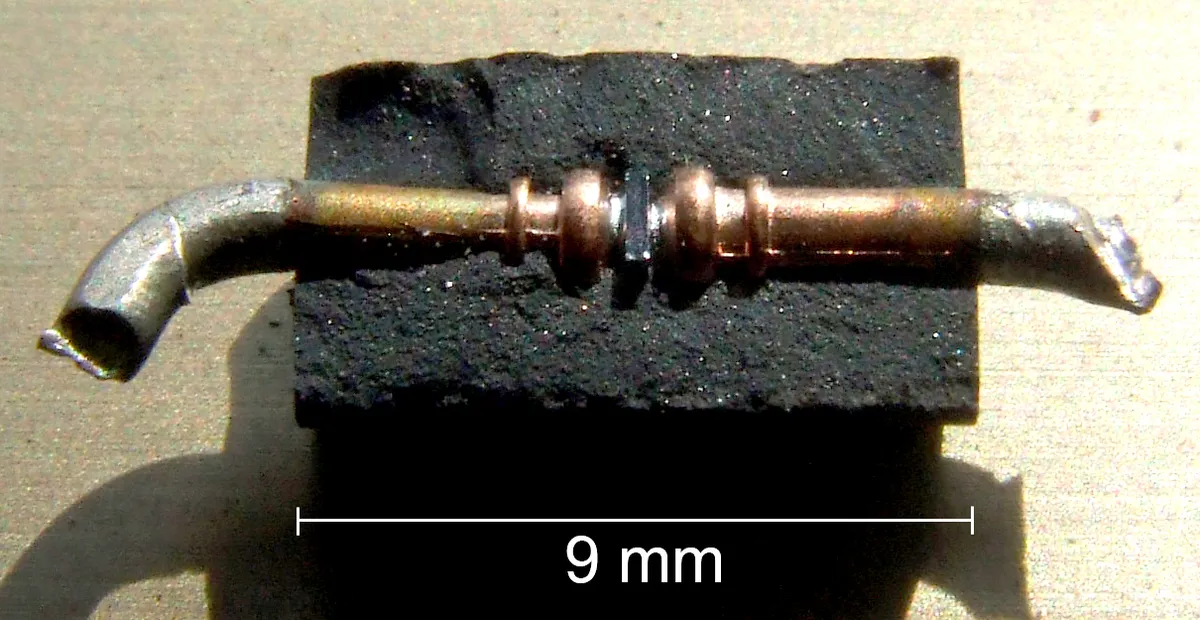
Inside a real Schottky diode (1N5822): the metal layer on silicon forms the special junction that makes it fast and efficient.
Photo: Laeman / Wikimedia Commons (CC BY 3.0)
A diode is the electronic version of a one-way valve: current can flow in one direction, but is blocked when it tries to go backwards. Schottky diodes are a popular variant used wherever designers want that one-way behaviour with as little power loss as possible.
What makes a Schottky diode different?
A normal silicon diode joins P-type and N-type semiconductor material. A Schottky diode instead uses a metal contact on N-type silicon. That sounds like a small materials change, but it changes the physics: the device switches faster and loses less voltage when conducting.
In numbers you will see on datasheets: a typical Schottky forward drop is about 0.2–0.4 V, while a standard rectifier might be 0.7 V or more at the same current. In a 5 A charger path, that difference is real heat and real efficiency.
Why do engineers care about speed?
When a diode turns off, it needs a moment to recover. Schottky diodes recover almost instantly compared with ordinary rectifiers. In a switching power supply that runs at tens or hundreds of kilohertz, a slow diode wastes energy on every cycle and creates electrical noise.
Faster recovery means cooler operation, smaller transformers and inductors, and sometimes a simpler EMI story. That is why Schottky parts show up in adapters, PC power stages, and DC-DC converters.
What is the catch?
No component is perfect. Schottky diodes leak more current in reverse and do not handle as high a reverse voltage or junction temperature as some PN rectifiers. They are a great fit for low-to-moderate voltage power paths, but not for every topology.
Rule of thumb: if the design prioritises efficiency and fast switching below roughly 100–150 V, a Schottky is often the first choice. If you need very high reverse voltage at high temperature, a standard or fast-recovery rectifier may be safer.
Where will you find them?
Phone and laptop chargers, solar optimisers, battery reverse-polarity protection, OR-ing two power inputs so the higher source wins, and freewheeling paths in motor drivers — these are everyday Schottky jobs.
Packages range from tiny SOD and SOT outlines on dense mobile boards to SMA, SMB, and SMC power packages in adapters and industrial modules.
Choosing a part from a catalogue
Match three things first: how much reverse voltage the circuit can see, how much forward current flows in normal use, and how much board area and heat sinking you have. Then compare forward voltage at your operating current — lower is better for efficiency, but watch leakage on battery-powered gear.
CTK lists Schottky diodes from small-signal to power rectifier packages. Each row in our product table links to electrical parameters and a PDF datasheet when available.