Why Is ESD Protection Important?
That small zap from a doorknob can kill a chip. Here is what ESD is, why it matters, and how protection parts keep your ports safe.
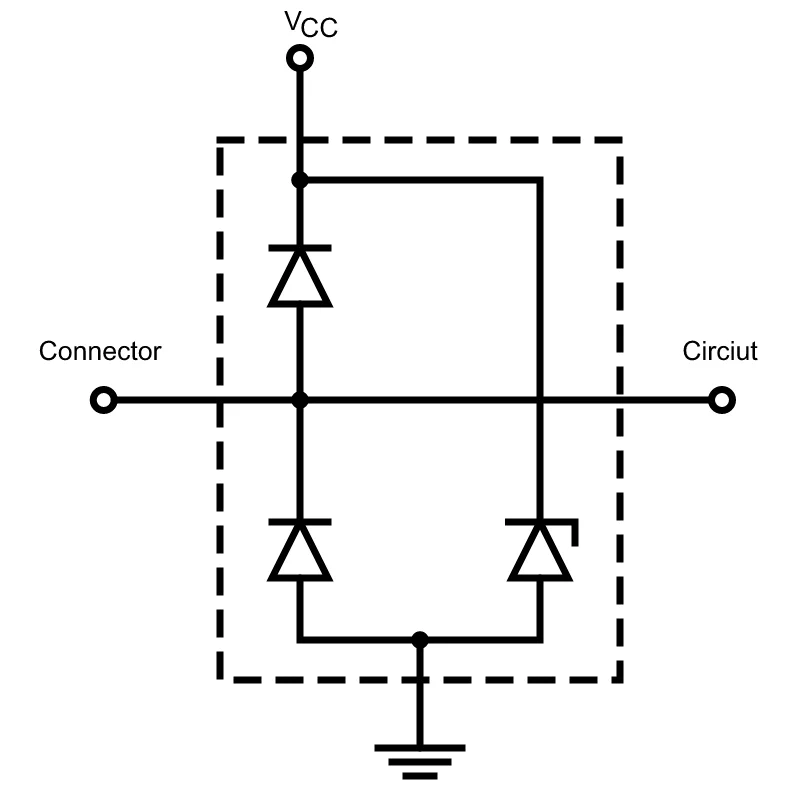
A simplified protection circuit: extra diodes sit between the outside world (connector) and the sensitive chip, shunting dangerous spikes to power or ground.
Illustration: Menner / Wikimedia Commons (CC0 1.0)
If you have ever touched a metal doorknob and felt a tiny shock, you have experienced static electricity. On a phone, laptop, or car ECU, that same kind of spark — often too small for you to feel — can destroy a chip that costs a few cents or a few dollars to replace, but far more to recall and repair.
What is ESD?
ESD stands for electrostatic discharge. In plain terms: a sudden burst of static electricity jumps from one object to another. Your body, a plastic tray, a cable shield, and a PCB can all build up charge during handling or everyday use.
Modern chips are built with extremely thin insulating layers. A spike that seems harmless to a human can punch straight through that insulation. The chip may fail immediately, or it may appear to work and then die weeks later in the customer's hands.
Why not rely on the chip alone?
Many ICs include a little on-die protection, but it is sized for normal board use — not for the repeated hits a USB port or HDMI socket sees over years of plugging and unplugging.
That is why designers add dedicated ESD or TVS parts next to connectors. Think of them as a safety valve: under normal conditions they stay quiet, but when a voltage spike arrives they turn on in nanoseconds and steer the energy away from the main processor.
Where does it matter most?
Any port a user can touch is a risk point: USB, HDMI, Ethernet, antennas, buttons, and sensor headers. Automotive and industrial gear faces extra surges from load dumps, relay switching, and long cable runs.
Factory floors use grounded wrist straps and ionizers because damage during assembly is just as real as damage in the field. Protection at the connector is the last line of defence once the product leaves the controlled environment.
How do engineers pick a part?
Start simple: the protection device must not interfere with normal signal levels, but must clamp before the main chip sees danger. Then look at how much surge current it can absorb and how low its capacitance is — high-speed USB and video lines are sensitive to extra capacitance.
Layout matters too. The protection part should sit right beside the connector with a short, direct path to ground. A great datasheet part in the wrong place on the PCB will still fail in testing.
What CTK offers
CTK manufactures ESD and TVS devices for single-line and multi-channel interfaces. You can compare stand-off voltage, capacitance, and package style in our catalogue and download datasheets for the parts that fit your design.